
Retail Did Not Come Back. It Quietly Became Something Else.
Retail did not “come back” to its old form. The growth is concentrated in uses that cannot be reduced to a delivery box: grocery, discount, healthcare, fitness, food and local services. The store itself has changed too—it may be a showroom, pickup point, return center and customer-acquisition channel at once. For owners, occupancy alone is not enough. The strongest centers are useful, operationally adaptable and built around repeat local needs. Retail survived by becoming something more specific.

Retail's comeback story is misleading because it suggests the old market disappeared and then returned.
What actually happened is more selective. The retail that is expanding is often the retail that cannot be reduced to a package on a doorstep.
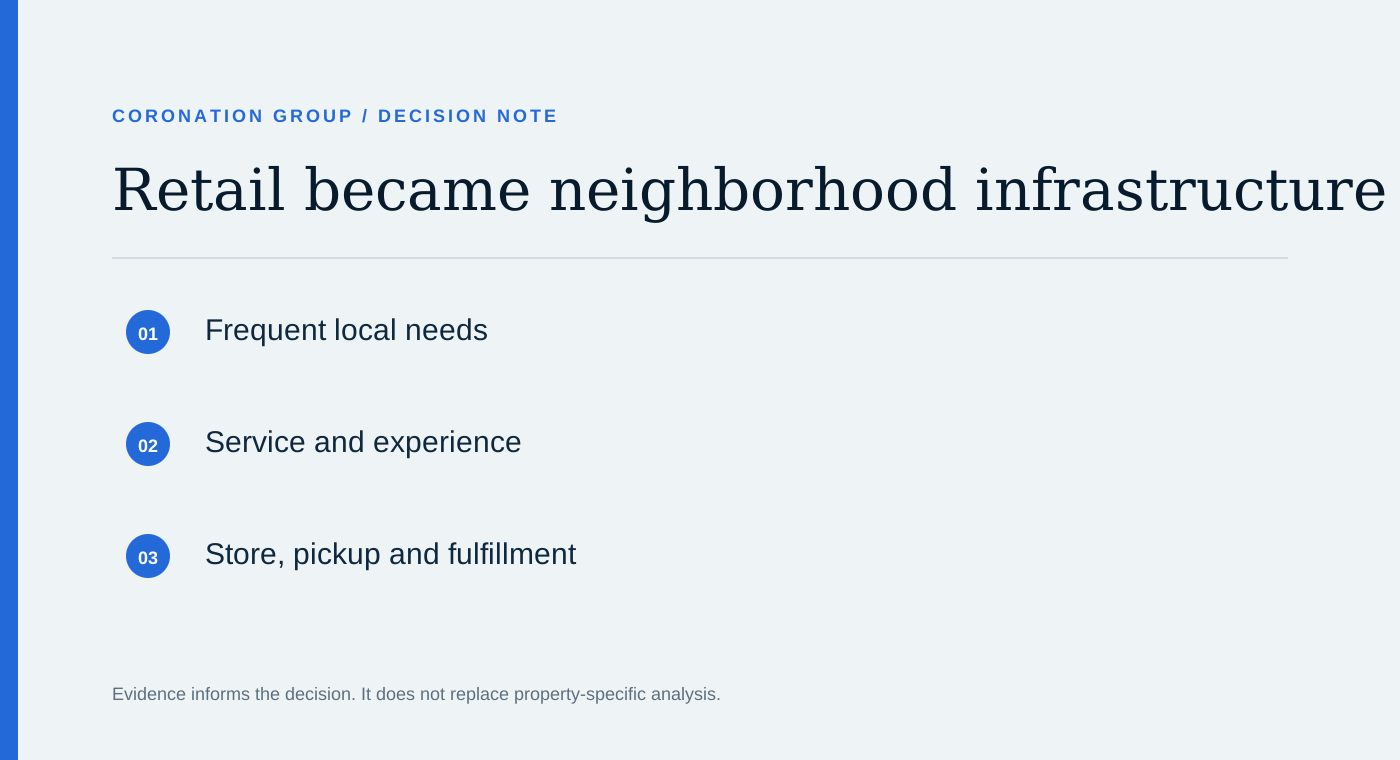
Grocery, discount and service businesses remain active because they solve frequent, local needs. CBRE's 2026 outlook identified grocery, discount and service retailers as important demand drivers. Its grocery research projected as many as 850 new stores in 2026, led by discount and food-focused operators, while noting that physical shopping accounted for most recent grocery-sales growth despite expanded online fulfillment.
That is not a return to the department-store era. It is a different tenant mix.
The contemporary shopping center increasingly functions as neighborhood infrastructure: food, healthcare, fitness, childcare, personal services, restaurants, pickup and convenience. Visits may be shorter, but they can be more frequent. The strongest centers combine necessity with experience and make several errands possible in one trip.
E-commerce did not become irrelevant. It changed the role of the store. Stores can now serve as showrooms, fulfillment points, return locations, service centers and customer-acquisition channels. For many retailers, the question is no longer physical versus digital. It is how each location supports the entire customer relationship.
This shift changes site selection. Household growth and income still matter, but so do trip patterns, visibility, parking convenience, delivery access, co-tenancy and the operational fit between the space and the concept. A retailer that depends on rapid turnover or pickup behaves differently from one that depends on lingering visits.
It changes ownership strategy too. A center filled with tenants may still be vulnerable if leases expire together, uses duplicate one another or the property lacks the infrastructure required by future operators. Electrical service, grease exhaust, loading, outdoor areas and signage can determine which tenants are realistically available.
Washington's development pipeline reflects part of this repositioning. WDCEP reported 136,000 square feet of retail construction starts in 2025, a 190 percent increase from the previous year, even as total development starts remained below the ten-year average. The number is less important than the contrast: selective retail investment continued inside a broader development slowdown.
The winning retail property is not simply occupied. It is useful. It serves a trade area repeatedly, adapts to changing formats and gives tenants a reason to operate physically.
Retail did not return to what it was. It became more local, more operational and less forgiving of space without a purpose.